A plumbing problem in one tenant space can quickly become a building management problem. You need to know what is affected, who needs access and what happens next, without chasing your contractor for updates. A useful commercial plumbing partner helps you manage the repair and its impact on the building.
For property and facility managers in Toronto and the GTA, that means looking beyond the repair itself. At Professional Plumbing Group (PPG), we coordinate with your building team, explain the findings and provide a clear record of the work so you can make informed decisions.
Know what is happening and what comes next
Good service starts with getting the right information before we attend. Where is the issue? Who are we meeting? Are there security requirements? Is the problem affecting one fixture, a tenant space or several floors?
Approval arrangements depend on the client. For established customers, a phone call may be enough to authorise additional work. Where an agreed spending limit would be exceeded, we provide a formal quote. When budget approval is needed, we address the immediate issue as appropriate and provide the relevant decision-makers with a follow-up quote within 24 hours.
If the repair is temporary or more work is required, we state that in the visit report and flag the job for office follow-up. You can tell the tenant or building owner what has been addressed and what still needs attention.
Plan the work around your tenants and building team
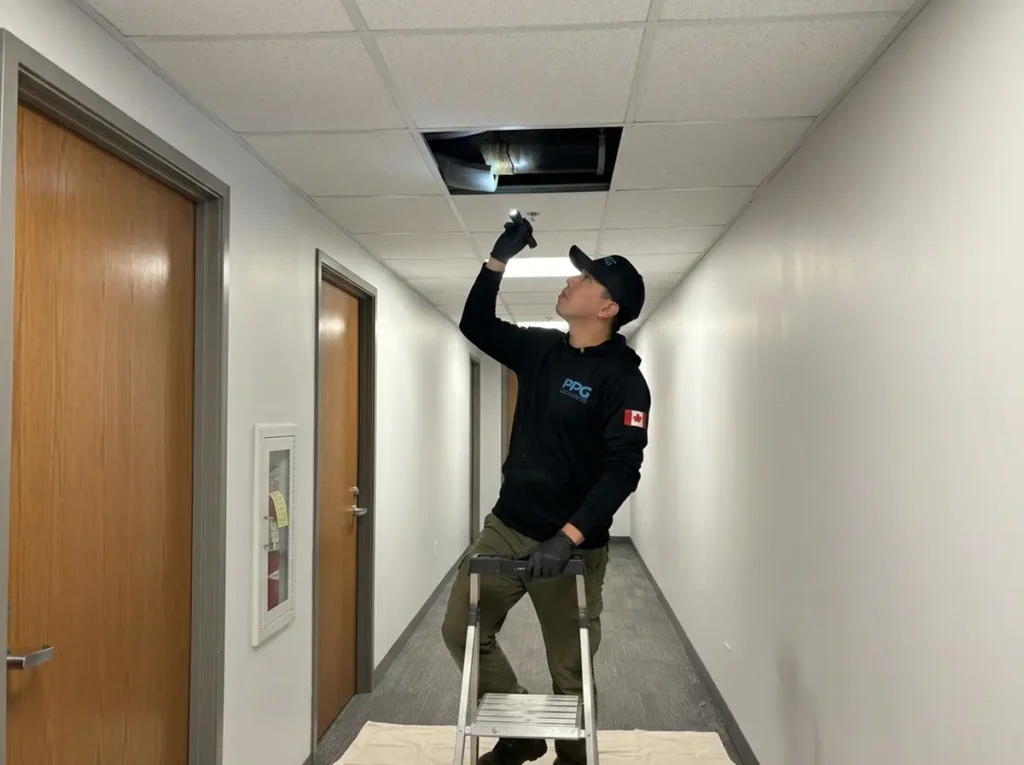
Working in an occupied commercial building requires planning. Isolating a water line can affect several tenants. Opening a ceiling may require access to someone’s office. Cutting or drilling may need to happen after hours.
We work with building operations to confirm access, identify shutdown requirements and plan the work around the people using the space. That also means protecting the work area, keeping things organized and removing our materials and debris when we’re finished.
Before a visit, we ask the person requesting the work about access arrangements, security and permits. Depending on the job, this may include roof access, hot work permits or coordination of smoke detection bypasses. Confirming these requirements with building operations helps make effective use of the scheduled work window.
At First Canadian Place, for example, PPG replaced cracked cast iron storm piping above a tenant space, removed the old pipe and insulation, installed firestop at the wall penetration and cleaned the area for use. The report documented those finishing steps as part of the completed job.
Investigate the cause and explain the limits of testing
If the same drain keeps backing up, we need to ask why. Clearing it gets things running again, but it may not address the cause.
At The Exchange Tower in downtown Toronto, PPG investigated a storm drainage leak after heavy rainfall. The initial camera inspection did not identify a significant defect. Direct inspection above a tenant ceiling, after removing wet insulation, revealed a large crack in a 6-inch cast iron pipe. The damaged section was replaced over a weekend while the affected space was closed, avoiding disruption to business operations.
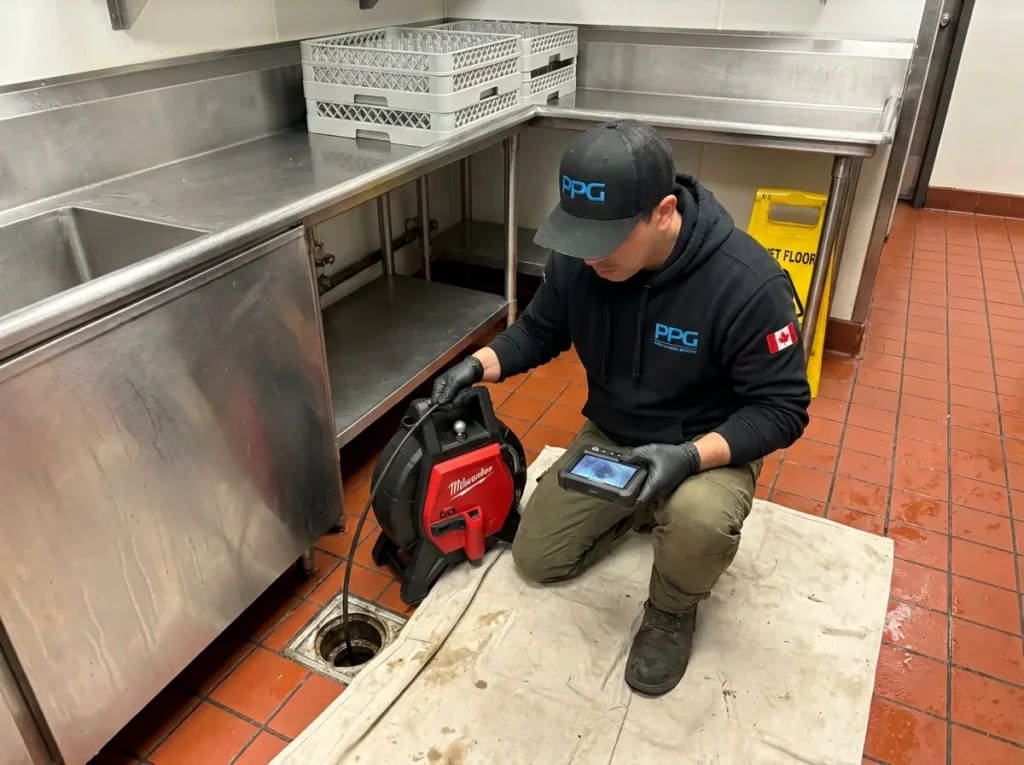
A camera inspection is one part of an investigation. What matters is understanding what has been inspected, what the findings establish and where further investigation is needed. If a section could not be inspected or a cause could not be confirmed, we make that clear.
Get a service report you can use
At the end of each visit, the technician sends a service report to the authorised contact who requested the work. Our standard report records who made the call, the exact location of the problem, what was found, how it was addressed and whether follow-up is required.
Photos are an important part of that. They show conditions above ceilings, behind walls, and in other areas the property manager may never see.
Reports include photographs of the completed work. Recommendations appear in the report or are attached separately, and jobs needing further attention are flagged for the office to follow up. That gives you a record to share with the owner, track against a work order and use when planning the next visit.
At Bay Adelaide Centre West Tower, the report documented the removal of approximately 20 feet of 10-inch cast iron storm piping and the installation of a cleanout for future service access. A return visit recorded the final support work and confirmed that the system was ready for service. The visit-by-visit record made the sequence and completion status clear.
Understand the scope before approving further work
PPG’s quotes provide a detailed description of the work, including what is and is not included. Where helpful, we attach marked-up photos to illustrate the proposed work. The scope also needs to account for access, shutdowns and coordination with other trades or building operations.
The aim is to give you enough information to approve the work confidently. You should understand what needs prompt attention, what requires further investigation and what can be planned around a future shutdown or budget.
Questions to ask before appointing a plumbing contractor
- Who will coordinate access, permits and any shutdowns with our building team?
- How will additional work be approved, including any agreed spending limit?
- What will the quote include, and which work or restoration is excluded?
- When will we receive the service report and photographs?
- How are temporary repairs, outstanding work and recommendations followed up?
Questions property managers ask about commercial plumbing
What should I look for in a commercial plumber for a managed property?
Look for relevant commercial building experience, a clear process for access and shutdown coordination, written scopes and useful service reports. Ask how the contractor communicates with your building team, documents work in concealed areas and identifies anything requiring a return visit.
What should a commercial plumbing service report include?
PPG’s report identifies who requested the visit, the building and exact location, the problem, work completed and any follow-up needed. Photographs document the completed work. Recommendations may be included in the report or attached separately, with further work flagged for office follow-up.
Can plumbing work be carried out in an occupied office building?
It depends on the work, access and affected services. PPG coordinates with building operations on access, shutdown requirements and scheduling around the people using the space. Some work may need to be arranged outside normal occupancy hours.
Does a clear camera inspection rule out every pipe defect?
A camera inspection does not necessarily establish the condition of every part of a system. At The Exchange Tower, PPG’s camera inspection did not identify a significant defect, but direct inspection after removing wet insulation revealed a cracked pipe. The findings need to be read alongside the inspection’s scope and limitations.
What information should I provide when booking a commercial plumbing visit?
Provide the building address, location of the issue, symptoms, affected tenants or services, and any relevant history or photos. Identify the site contact, access and security requirements, work windows and who can approve additional work. Confirm any shutdown arrangements with the building team.
Get a clearer plan for your building’s plumbing
A useful commercial plumbing partner gives you more than a completed work order. You need a clear account of the problem, an agreed plan for the building, and a record of the work to help you manage what comes next.
Email service@ppg.works with your building location, the issue you are managing and any access or scheduling constraints. We will discuss your commercial plumbing service and maintenance requirements in Toronto and the GTA and review the next steps.
About the author
Jon Carter is a licensed plumber and co-owner of Professional Plumbing Group (PPG). He works with property and facility managers and multi-location businesses on their commercial plumbing needs in Toronto and the GTA.